Joseph B. Moore
President 2007-Present
2012-AIB celebrates 100 years. Threshold celebrates 30 years. Lesley begins a relationship with Teacher Created Materials (TCM), a publisher of professional resources for teachers with six faculty members authoring titles in 2012. Lesley University presents the Boston Speakers Series, a lecture series at Boston's Symphony Hall featuring distinguished activists, authors and world leaders. President Moore welcomes President Bill Clinton, the inaugural speaker for the 2012-2013 season.
2011-A collection of essays by Lesley faculty members entitled A Century of Innovation: Lesley University is published. Lesley University creates a partnership with Cambridge's Kennedy-Longfellow school after receiving a $2 million gift from Albert Merck, philanthropist and former director of Merck & Co., Inc., and his wife Kate. The collaborative relationship with the Kennedy Longfellow school focuses on curriculum, the integration of digital technology, and student learning outcomes.
2010- New facilities added to Lesley's physical plant in
Cambridge, including additional academic and library space, enhanced
space for student services, additional residence halls, and a second
dining hall
2009-Lesley University began a year-long Centennial Celebration.
2008-Lesley University received a $136 million gift from former trustee Frank C. Doble. The largest gift in the University's history tripled the endowment and fueled growth, scholarships, and new facilities. The University and the Episcopal Divinity School entered a new partnership with a shared vision for future facilities and partnerships.
2007-Joseph B. Moore was selected as Lesley University's President
Margaret A. McKenna
President 1985-2007
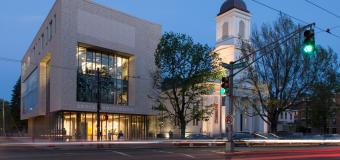
2007—The School of Education moved to its new location in University Hall (the former Porter Exchange Building).
2006—The Ph.D in Expressive Therapies program graduated its first students.
2005—Lesley University launched its third Ph.D. Program in Education Leadership. Male undergraduate students began classes.
2004—Lesley College became co-ed, admitting men in the undergraduate
school for the first time in its history. Lesley University launched its
comprehensive brand marketing campaign, "Let's Wake up the World." The
Art Institute of Boston established a BFA in Animation.
2003—Programs in Management for Business and Industry (PMBI) closed.
Princeton Review selected Lesley University as among "The Best
Northeastern Colleges."
2002—The Radcliffe Seminars in Creative Arts were taken over by Lesley University. The MFA in Creative Writing Program began.
2001—U.S. News and World Report ranked Lesley University as one of the
"best regional Universities." Oregon became the 17th state to join
Lesley University's national program.
2000—Lesley College became Lesley University and the Women's College was
renamed Lesley College. A Ph.D. in Expressive Therapies was introduced.
1999—The Institute for Mind, Body, and Spirituality was established to
promote inquiry, train professionals, conduct research, develop new
programs, and provide leadership in the area of mind-body health, and
education. Lesley received an award from the Victorian Society of
America for preserving the Victorian character in Cambridge.
1998—AIB became Lesley's sixth school.
1997—The Center for Special Education was created and the first online
degree program, the 11-course Technology in Education master's, began.
1996—The Lesley faculty juried an online journal, The Journal of
Pedagogy, which debuted this same year. Online courses were offered for
the first time.
1995—Lesley College became a member of the National Collegiate Athletic Association (NCAA), Division III.
1994—Porter Exchange, the former Sears building, was purchased by Lesley
College. The Graduate School of Arts and Sciences was created.
1993—Reggio Emilia Inspired Institute was founded. Lesley also hosted
its first "Making Schools Safe for Gay and Lesbian Youth" conference.
1992—The library was renovated and dedicated as the Eleanor DeWolfe
Ludcke Library. Lesley College awarded its first Ph.D. in Education.
1991—The Reading Recovery Center—the New England regional site for
teacher training—opened at Lesley College. "Say Yes to Education," a
Lesley College-administered free college education program, began.
1990—Lesley College celebrated its 80th anniversary and admitted its first Ph.D. students in education.
1988—The Art Institute of Boston awarded its first class of BFA degrees.
1987—The Ph.D program was approved by the New England Association of
Schools and Colleges (NEASC). The Center for Mathematics, Science and
Technology in Education was established. An affirmative action policy
was approved by the Board of Trustees; Lesley College held off-campus
programs in Colorado, Massachusetts, Missouri, New Hampshire, New
Mexico, Nebraska, Wisconsin, and Wyoming as well as international sites
in Brazil, Greece, Israel, Mexico, Sweden, Switzerland, and West
Germany.
1986-The Intercultural Relations Program, the first of its kind, was
established, focusing its curriculum on the interpersonal aspects of
communication and understanding across cultures.
1985—Margaret A. McKenna was inaugurated as Lesley College's President.
Don Orton
President 1960-1985
1984—Lesley's National Outreach Program in Denver, Colorado, was
launched with a Counseling Psychology Certificate which initiated the
first off-campus program delivered outside New England. Lesley
also celebrated its 75th anniversary with 475 undergraduates, 1,259
graduate students on campus, 1675 graduate students off campus, 40
buildings, and 476 employees.
1982—The Threshold Program began under the auspices of Professor Arlyn
Roffman who created the non-degree, campus-based program for young
adults with diverse learning disabilities and other special needs. A
this same time, the Art Institute of Boston (AIB) received the National
Association of Schools of Art and Design accreditation.
1981—The accelerated program for working adults, Programs in Management
for Business and Industry (PMBI), was established at the same time the
Lesley College Graduate School of Education became the Lesley Graduate
School.
1979—The Technology in Education Graduate Program at Lesley was the first of its kind to be launched in the United States.
1980—Audubon Expedition Institute (AEI) was launched enabling students
to earn their bachelor and master's degrees by traveling across the
country on a bus and learning about the environment by living in it. At
the same time, the Expressive Therapies training program was offered to
professionals in Israel and at home, the Adult Baccalaureate Program
began for older students trying to balance full-time jobs with earning
an undergraduate degree.
1978—AIB received accreditation from the National Association of Trade
Schools; the Lesley Graduate School included five areas (Education,
Management, Counseling Psychology, Institute for Arts and Human
Development, Outreach and Alternative Education) with 18 different
programs.
1976—The Creative Arts and Learning Program began under the direction of
Iris Fanger as the only program in the United States that had an
interdisciplinary, arts-based education; Program Evaluation and Research
Group (PERG) started by professors George Hein and Brenda Engel
initiated an alternative to standardized assessments of students'
progress using a quantitative assessment program; to extend skills
beyond the Master's level, the Certificate of Advanced Graduate Study
(CAGS) was developed by Professor George Hein as an interdisciplinary
program for professionals.
1975—The Counseling and Psychology Program began with 21 students,
blending instruction in theory with field experience and with a
self-awareness focus of the counselor-in-training.
1974—Institute for Arts and Human Development was created by Professor
Shaun McNiff with an Expressive Therapies track and an Arts Education
track, the first of its kind in the United States to integrate the arts,
dance, theater, psychodrama, music, poetry, and the visual arts with
the practice of psychotherapy.
1973—The renovations of the 1965 plan were completed after 8 years of planning and construction.
1970—AIB moved to Kenmore Square and the Independent Study Program of
the Graduate School began with five students who designed their own
courses of study.
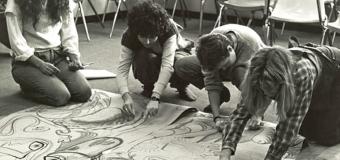
1968—Lesley students went on strike to demand more rights. Changes were
made in the curriculum, curfew, schedule, and living arrangements.
1967—Gertrude Malloch died, leaving her house to the College to be used
"as a home for the president of Lesley College;" Mellen Street was
incorporated as the street that bisected the campus; the School of
Practical Art was renamed the Art Institute of Boston (AIB),
establishing itself as a non-profit institution of higher education; the
Graduate Center opened at 9 Mellen, the first Graduate School building
on campus; the College consisted of 28 buildings, 550 undergraduates, 25
graduate students, and 225 employees.
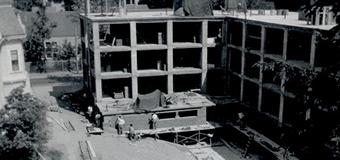
1965—New buildings were constructed creating a quadrangle and housing a
new library, dorm space, faculty and administrative offices and
classrooms.
1962—The New England Kindergarten Conference was started by the Lesley Graduate School.
1960—Don Orton was appointed as the President of Lesley College. Due to a growing interest in the field of learning disabilities, graduate training for special education teachers was offered.
Sam Wonders
Acting President 1959-1960
1959—President Trentwell Mason White unexpectedly died and Sam Wonders, President of the Board of Trustees, served as acting president. At this point Lesley had a total of ten buildings, 380 undergraduates, 52 graduate students, and 79 employees.
Trentwell Mason White
President 1944-1959
1958—The newly-built Trentwell Mason White Hall, a dormitory and dining room, opened.
1955—The first five students of the Graduate School received their degrees.
1953—Edith Lesley Wolfard died. During a tribute held in her honor on
May 21, President Trentwell Mason White recalled Edith's advice to him:
"The girls at Lesley will give their best when the best is expected from
them. Insist on these standards. Demand the top not the second-rate."
1950—Stebbins Hall was built, adding two floors, including a library, above Alumni Hall.
1949—Three private elementary schools (Lesley-Ellis, Dearborn, and
Carroll-Hall) were acquired to provide students a "Laboratory for
Learning."
1948—The Lesley College Alumnae Association created its first annual
semester tuition scholarship for degree candidates who had completed
their freshman year and were held in high academic standing.
1945—The first of five bachelor's degrees was awarded in June, and the home economics department was abolished.
1944—Trentwell Mason White became president and Clara Thurber became the first Dean of Lesley College. Mason wrote the school song "Loyal Lesley Daughters" in his efforts to create a sense of tradition for Lesley's 86 students and 28 employees.
Marguerite Franklin
President 1943-1943
1943—Marguerite Franklin was hired as President to transition the Lesley School to Lesley College.
Gertrude Malloch
Chief Administrator, 1938-1943
1943—The Lesley School became a four-year, not-for-profit educational
institution and was authorized by the state of Massachusetts to be
renamed Lesley College and given the right to award the Bachelor of
Science in Education degree.
1941—The first Board of Trustees was established to make Lesley a school of "collegiate caliber."
1940—According to the Alumnae Association, Lesley School graduates
totaled well over 2,000 and were scattered across the United States and
around the globe.
1939—The Department of Domestic Science was renamed the Department of
Home Economics and, after 30 years of private ownership, the Lesley
School was incorporated as a non-profit institution.
1938—Gertrude Malloch was appointed Chief Administrator as Edith Lesley's health began to decline.
Edith Lesley
Founder of Lesley College, 1909-1938
1934—With the Depression taking its toll on enrollment, the Lesley
School had only 63 students taking classes with tuition at $220 per year
for the Teacher Training Program and $390 per year for the Domestic
Science Program. A $325 fee was charged per year for use of the
dormitories.
1932—To get admitted to the Lesley School, one had to meet the following requirements:
1.Graduation from a four-year high school or from an accredited three-year high school on the junior plan
2.Transcript of high school credits
3.Letter of recommendation from a teacher and a business reference
4.A doctor's certificate for a good bill of health
5.A "glossy" 4 X 6 head shot without a hat
6.Ability to sing and play piano (for the Kindergarten-primary training program only)
1930— Edith Lesley Wolfard added her family coat of arms, two griffins
holding a field medal, to the furnishings from around the world she
collected to make the school as "homey as possible." She then adopted
for the school the coat of arms' motto, "I had perished had I not
persisted." Edith's ancestry was connected to Lord Newark, David Leslie,
who received his title in August 1660 for valor during a battle against
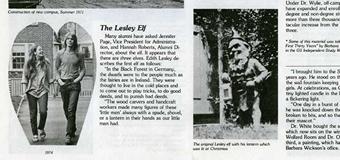
the invasion of Scotland by England, led by Oliver Cromwell. The elf,
another of Edith Lesley Wolfard's collection, was adopted as Lesley's
mascot, and his lantern was lit for celebrations.
1928—Enrollment at the Lesley School reached more than 300 students,
both boarding and day, and 75 courses were offered for students of
Kindergarten Training, Primary Training, and Domestic Science in the
following year.
1924—The first yearbook, The Lesleyan, was printed.
1922—Alumni hall was built as an assembly hall with classrooms in the
basement after three adjoining properties were acquired. The tuition for
the school year was $200 plus $550 a year for room and board. Practice
teaching and observation were added to the curriculum of the Department
of Kindergarten Training and the Department of Primary Training.
1921—Edith Lesley Wolfard and her husband, Merl Ruskin Wolfard,
converted their summer home in Bridgewater, New Hampshire into the
Lesley Camp where students could study during the summers and earn
certificates in various subjects from handicrafts to sports.
1920—Lesley Normal School changed its name to the Lesley School.
1918—The department known first as Domestic Science (later, 1939-1940,
as Home Economics) was established, offering a one- or two-year program
which prepared students to work in various public institutions,
including schools and hospitals. Gertrude Malloch, who served as both a
teacher and an administrator, was named Principal of the Lesley Normal
School.
1913—Forty of 43 Lesley Normal School Graduates were teachers. The other
three were married and were therefore not allowed to hold teaching
positions.
1912—Classes in household arts were added and the Art Institute of
Boston (AIB) was founded by Roy Davidson as the school for Practical
Art. It was one of the very first private non-affiliated studio schools
in the United States and was housed in Davidson's own studio which
consisted of three small rooms in Boston's Back Bay.
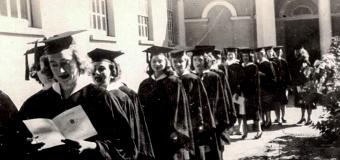
1911—Eleven students graduated in the first class at the First Parish Church (Unitarian) in Harvard Square in Cambridge.
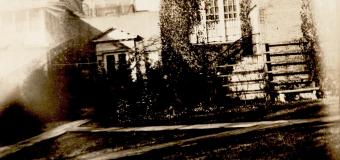
1909— September 17, 1909, Miss Edith Lesley welcomed her first class in the living-room of her home at 29 Everett Street, Cambridge. Edith Lesley opened "The Lesley Normal School" ("normal" at the time designating teacher training schools) to train young women to become kindergarten and early elementary teachers. Influenced by the philosophy of German educator Friedrich Froebel, Lesley's two-year curriculum stressed the importance of physical activity (singing, dancing and gardening) and play, particularly with blocks and similar objects. Edith Lesley also stressed the values of treating students as individuals and the importance of 'gracious living.' Tuition was $100 a year and of the nine first-year students, Anna Tikkonnnen, an international student from Finland, was the first student enrolled.