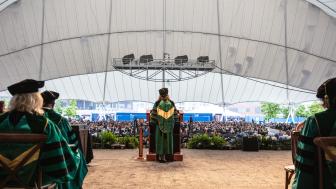
The Panel Discussion, which drew hundreds of people to Washburn Auditorium on Lesley’s Brattle Campus on Wednesday evening, coincides with Revolutions, an exhibit of Ochlik’s powerful photographs presented by Lesley’s Art Institute of Boston (AIB) and the Consulate General of France in Boston.
The panelists relayed what drives journalists like Remi Ochlik, who must undertake great personal risk to respectfully and objectively observe other cultures and translate that into photos, videos, documentaries and articles.
“I think you need commitment, to be passionate,” said panelist Karim Ben Khelifa, a Belgian-Tunisian photojournalist who has covered world conflicts for 15 years. “You need to be a little nuts. And you need to care for the others. You need to not only leave the comforts of your zone and where you live, but to project yourself in places that are not always attractive.”
To cover war and revolution, journalists must go places where most people would walk away, he said.
“I’m not going there comfortable, I’m not going there smiling – I’m going there with a sense of duty,” said Khelifa, co-founder and CEO of Emphas.is, a website designed to promote crowd-funded visual journalism.
The other panelists were veteran journalist and Columbia University professor Judith Matloff; Ludovic Blecher, editor-in-chief of the French newspaper Libération; and Stephen Mayes, Director of VII Photo in New York and former Vice President of Getty Images, who moderated the discussion.
In a ranging and intense discussion, the panelists tackled issues including safety for foreign correspondents and the challenges journalism faces in the age of technology and social media.
In the context of the Arab Spring, Matloff described a “parallel revolution” that has stemmed from the uprisings in the Middle East, which is the recognition that female correspondents have long suffered silently the burden of harassment and sexual assault. She said the lid was blown off by CBS correspondent Lara Logan, who came forward after being brutally sexually assaulted by a mob of men in while covering the Egyptian revolution in Tahrir Square, Cairo.
“When someone gets shot, all your colleagues come to visit you in hospital,” said Matloff, who has been a journalist for 30 years and will soon publish her third book. “When you get raped, nobody talks about it.”
Now more than ever, she said, safety is on the table - for both male and female correspondents. And while female foreign correspondents face additional obstacles doing the same work as male correspondents, Matloff said they are often able to get closer to people, particularly in societies where the gender division is more stratified.
“When you’re dealing with civilians, like children and women, they will feel less threatened by women,” Matloff said.
“Women get to bring things back that men can’t,” Khelifa echoed.
As an editor of a major Paris-based newspaper, Blecher noted the complicated relationship between journalism and social media. By many measures, social media is an important tool that democratizes and offers a perspective in places where journalists can’t go or aren’t present. However, social media offers a voice from within a movement that can manipulate the story, he said, so the role of the expert in the newsroom is to bring context.
“As I see it, in some ways, journalists have never been so important as they are today,” said Blecher.
He and the other panelists lamented the struggle to fund quality news coverage in the age of dwindling print journalism and an evolving business model.
“We have a very huge circulation, but the problem is the people are reading the news for free,” said Blecher. “We have also to find a way to engage people differently. If we want to have the same level of democracy in five, 10, 20 years, you also have to pay for information.”
In the context of the Arab Spring, Mayes spoke directly to the audience of community members and Lesley students, faculty and staff, and he put the onus on consumers of news to be engaged in the unfolding revolutions in the Middle East and North Africa.
“We all have a part to play in what happens next in this continuing story that is far from finished,” Mayes said.
“Remi’s pictures don't have to die with him”
Remi Ochlik was killed in the February 2012 bombardment of Homs during the Syrian uprising along with veteran American journalist Marie Colvin, who was working for The Sunday Times of London.
During opening remarks at Lesley’s Panel Discussion, Fabien Fieschi, Consul General of France in Boston, said
Ochlik’s death – and the injury, abuse and death suffered by journalists around the world – are a tribute to the risks journalists undertake as they attempt to convey people’s aspirations and thirst for democracy.
“It should remind us of the toll taken on men and women who have sought to inform us on what we’ll see in the future as some of the defining moments of this decade,” Fieschi said.
Khelifa said journalists face a personal choice of how far to push themselves, and in his career, he has pulled back and stayed away from certain places or situations when his instincts tell him to.
“We talked about Remi Ochlik’s work. He was passionate. I wouldn’t do what Remi has done… I wouldn’t go to Syria tomorrow,” said Khelifa. “I’ve been doing this for 15 years… I wouldn't stop anyone else from going. It’s your life and your story and your commitment and passion.”
Other speakers who welcomed the audience included Stan Trecker, Dean of Lesley’s Art Institute of Boston, Lesley University President Joseph B. Moore, and Delphine Halgand, a representative from Reporters Without Borders, one of the sponsors of the exhibit.
Halgand, whose organization has fought for freedom of the press and worked to report on press freedom violations since 1985, said the panel discussion at Lesley was an opportunity to remember the 191 journalists in prison today around the world, especially the 72 imprisoned in Turkey, as well as those journalists who are missing and those who have been killed. She encouraged the audience to visit the Revolutions exhibit at AIB and honor the work of Remi Ochlik and others.
“As his girlfriend wrote to me, ‘Remi’s pictures don't have to die with him,’” said Halgand. “So we have to show his pictures – and we will.”
The exhibit, free and open to the public, is on view in the AIB Main Gallery through February 22 – the one-year anniversary of Ochlik’s death. Learn more here.
Revolutions is curated by Arnaud Brunet and Jean-Francois Leroy, and produced by Zoom photo festival Saguenay, International Conference of Photojournalism and La Pulperie de Chicoutimi, Regional Museum.