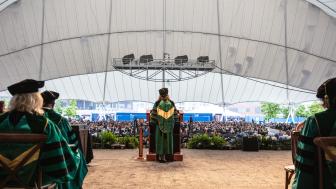
Fox, who served as president of Mexico from 2000 through 2006, presented his perspective on the global economy, with a focus on Latin America and the United States. He declared that the U.S., as well as the European Union, are at a crossroads as the world’s major powers transition from the 20th to the 21st century. He warned that the Chinese and Indian economies are on track to surpass the U.S. and European economies within the next seven years unless there is significant commitment to economic growth and ingenuity.
“We’re trying to build a better future for all of us, and I really think that this future is in North America,” said Fox, who was the first president of Mexico to be elected from an opposing party since 1910.
Fox called on all parties to reorganize and reenergize the North American Free Trade Agreement (NAFTA), an agreement that was signed 19 years ago by Canada, Mexico, and the United States to create a trade bloc in North America.
“We are partners and we can build jobs on both sides of the border,” asserted Fox. He said NAFTA enabled a strong middle class to develop in Mexico while also creating many jobs for U.S. citizens, but that it seems to be “dormant” and non-responsive now. “Even China and India today are negotiating trade agreements. … Today, the way to go is trade partnership and blocs.”
In the context of critiquing the current state of Europe’s economy, debt and fiscal practice, Fox asserted that “productivity and hard work can create growth,” not governments.
“Government creates wealth? What a lie. What a monumental lie,” he exclaimed. “…Entrepreneurship and hard work: That’s what the private sector does and that’s the real creator of jobs, the real creator of growth,” he said, prompting a round of applause.
Reflecting on modern Latin American history, Fox said growth was stifled by dictatorships and authoritarian governments for most of the 20th century. Without freedom, there is no creativity or entrepreneurship, he said, but democratization began to turn things around starting in the 1980s and 90s.
“The basic fundamental values to build a nation are democracy and freedom,” said Fox. “It makes everyone feel responsible to construct the nation. … The last 10 years, Latin American (economic) growth has been close to 6 percent for the whole region, while in the United States it’s close to 2 percent, and in Europe not even 1 percent.”
To set the U.S. on a steady course, Fox said it’s imperative that it tackle immigration reform once and for all. He criticized today’s Republicans and Democrats for their inability to work toward consensus, and recalled the immigration reform plan led by Senators Ted Kennedy and John McCain.
“I hope this is it and that reform will go through,” he said. “Up to now, we’ve been building walls, and walls don’t work. It’s been a waste of all the money taxpayers have spent.”
Touching briefly on the drug trade and drug cartels, Fox insisted that Mexico is a victim of location – caught between the countries that grow drugs to the south and the countries that consume them to the north, mainly the U.S. He added that Mexico’s dangerous reputation is overstated by the media.
“This situation is badly hurting our nation,” said Fox, who suggested two options for the United States to remedy the crisis. Either “enforce the law,” he said, or “move to a new paradigm of legalization,” which he likened to the legalization and regulation of alcohol after Prohibition.
“At the very end we must find a solution,” said Fox.
Following his speech, Fox engaged in a Q&A session moderated by Phil Redo, managing director of WGBH-FM. He fielded questions on corruption in Mexico and the effect of Hugo Chavez’s death on Latin America, and was asked for his reaction to the news that Cuba’s President Raul Castro announced his retirement.
“Late but welcome,” he said of Castro’s announcement, inciting a round of applause. He praised Cuba’s excellence in education and medicine, and said that “the day Cuba comes back to be a democratic nation and its people and media to be free, they will be champions.”
During the introduction at the start of the evening, Redo announced the 2013-2014 lineup for the Lesley University Boston Speakers Series. To read about next year’s series and the array of speakers who will be welcomed to Symphony Hall, click here.