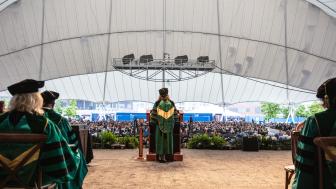
He told the tale of his unique journey of activism that included a 17-year vow of silence, and a 22-year renunciation of motorized transport as he walked from California to the East Coast. Along the way, he earned a Master’s degree in environmental studies and a Ph.D. in land studies, all without speaking.
It all began with an oil spill in 1971 in the San Francisco Bay, where he was appalled by the sight of dying birds covered in crude and the wretched smell permeating the atmosphere. Francis, then a self-described 20-something “hippie,” said that experience ignited a fire within him that catalyzed the path he’s taken, a journey that continues to this day.
A colorful and expressive storyteller, Francis used sweeping gestures – his own version of sign language that he developed to communicate with people across the country during his years of silence – to tell the arc of his story, and express his belief that environmental awareness is about much more than pollution and saving endangered species; it’s about human rights and equity.
“How we treat each other is really manifested in the physical environment around us,” Francis reflected. “So what’s really important is our relationship with each other and how we treat one another, because that’s how things seem to get messed up or out of balance.”
He talked about sleeping in the wilderness, traveling everywhere by foot, learning to deeply listen, and developing a new level of consciousness and alertness as he walked the Western Hemisphere. He explained his family’s perplexed frustration at his silence and how he attended colleges, and even taught courses, without speaking, ultimately earning his Ph.D. at the University of Wisconsin. He painted water colors every day, wrote, kept journals and crafted poetry.
Those life experiences contributed to his education. Using only written communication, gestures and images, he enrolled in schools, including Southern Oregon State College, which gave him credits for life experience at a bargain price toward earning his bachelor’s degree – one of the many gestures of good will bestowed upon him.
He wrote to the University of Montana two years before his trek on foot finally delivered him there, a wanderer with no funds to support his studies.
“I didn’t have any money,” Francis recalled. “They said, ‘Come back tomorrow, and we’ll take care of it.’”
Finally, he was given a fellowship at the University of Wisconsin, where he earned his Ph.D.
When he finally broke his 17-year silence, in 1990, he spoke on the 20th anniversary of Earth Day in Washington, D.C., where reporters, along with his family and friends, gathered to cover the momentous event.
“I hadn’t heard myself in so long that I turned around to look and see who was talking. Then I realized it was me," he recalled. "I thought that was pretty funny, because I didn’t recognize my own voice.”
Soon thereafter, having developed a reputation as an environmental expert, he was tapped by the U.S. Coast Guard to write pollution regulations for the nation’s waterways.
“The power of walking”
During his pilgrimage, Francis walked across the United States and earned a B.A. at Southern Oregon State College, an M.S. in Environmental Studies at the University of Montana, and finally, his Ph.D. at the University of Wisconsin.
He later sailed and walked through the Caribbean, and then walked the length of South America. In 2003, he met Dr. David Morimoto, Division Director of Natural Sciences and Mathematics at Lesley, who was in Cuba to participate in the 2003 International Convention on Environment and Development. After meeting Francis, Morimoto extended his trip to participate in Planetwalk Cuba and discovered “the power of walking.”
“Planetwalk Cuba really taught me that one step at a time, the world unfolds to you,” said Morimoto, who spoke at the start of Francis’ lecture. “It’s not science alone; it can never be science alone. As an academic institution we can take a good lesson from that; that really, learning is interdisciplinary.”
Francis was introduced to the audience by Lesley junior Dylan Bushe, a dual major in Environmental Studies and Middle School Education.
John Francis and Lesley Conversations
Francis concluded the 2012-2013 Lesley Conversations series, which brought a range of leading thinkers to campus, including prominent political analyst David Gergen and Far from the Tree author Andrew Solomon.
Francis is the author of the autobiographical Planetwalker. 22 Years of Walking. 17 Years of Silence. In 2011, his second book, The Ragged Edge of Silence: Finding Peace in a Noisy World, was published by the National Geographic Society.
He believes the current environmental crisis is a reflection of worldwide social and economic inequity, and that attempts to resolve the crisis must address not only the scientific issues, such as climate change and deforestation, but also the humanitarian issues. He contends that our connection to the earth and to each other is at the heart of the environmental crisis.
Lesley Conversations are designed to inspire thought-provoking discussions in the Lesley community and beyond, and to provide opportunities to think about issues influencing American and global policy. Their mission is to foster critical inquiry, active learning, and scholarly underpinnings in our actions as citizens and leaders in an interdependent world.
View the video of John Francis' presentation at Lesley